Sequential Monte Carlo (Particle Filter) Methods
pfilter.RdImplementation of Sequential Monte Carlo (SMC) methods, also known as particle filters, for state space models. These methods extend Kalman filtering to nonlinear and/or non-Gaussian state space models.
Usage
pfilter(
  model,
  y,
  method = c("sir", "apf", "optimal"),
  N_particles = 1000,
  resampling = c("systematic", "multinomial", "stratified"),
  ess_threshold = 0.5,
  P1 = NULL,
  a1 = NULL,
  ...
)

# S3 method for class 'stspmod'
pfilter(
  model,
  y,
  method = c("sir", "apf", "optimal"),
  N_particles = 1000,
  resampling = c("systematic", "multinomial", "stratified"),
  ess_threshold = 0.5,
  P1 = NULL,
  a1 = NULL,
  ...
)
Arguments
- model
stspmod()object, which represents the state space model. For nonlinear models, additional parameters may be required.- y
sample, i.e. an \((N,m)\) dimensional matrix, or a "time series" object (i.e.
as.matrix(y)should return an \((N,m)\)-dimensional numeric matrix). Missing values (NA,NaNandInf) are not supported.- method
Character string specifying the particle filter algorithm. Options:
"sir"(Sampling Importance Resampling, default),"apf"(Auxiliary Particle Filter),"optimal"(Optimal proposal for linear Gaussian). Note: The APF method may produce biased likelihood estimates for models with cross-covariance between state and observation noise (S != 0). For linear Gaussian models with cross-correlation, the optimal proposal is recommended.- N_particles
Number of particles to use (default: 1000).
- resampling
Resampling method:
"multinomial","systematic"(default), or"stratified".- ess_threshold
Effective sample size threshold for triggering resampling (default: 0.5). Resampling occurs when ESS < ess_threshold * N_particles.
- P1
\((s,s)\) dimensional covariance matrix of the error of the initial state estimate, i.e. \(\Pi_{1|0}\). If
NULL, then the state covariance \(P = APA'+B\Sigma B'\) is used.- a1
\(s\) dimensional vector, which holds the initial estimate \(a_{1|0}\) for the state at time \(t=1\). If
a1=NULL, then a zero vector is used.- ...
Additional arguments passed to filter implementations.
Value
List with components
- filtered_states
\((N+1,s)\) dimensional matrix with the filtered state estimates. The \(t\)-th row corresponds to \(E[x_t | y_{1:t}]\).
- predicted_states
\((N+1,s)\) dimensional matrix with the predicted state estimates. The \(t\)-th row corresponds to \(E[x_t | y_{1:t-1}]\).
- particles
\((s, N\_particles, N+1)\) dimensional array containing the particle trajectories.
- weight_trajectories
\((N+1, N\_particles)\) dimensional matrix of particle weights over time. The \(t\)-th row corresponds to weights at time \(t\).
- weights
\((N\_particles)\) dimensional vector of normalized particle weights at final time.
- log_likelihood
Particle approximation of the log-likelihood.
- log_likelihood_contributions
\((N)\) dimensional vector of log-likelihood contributions per time step.
- effective_sample_size
\((N+1)\) dimensional vector of effective sample sizes.
- N_particles
Number of particles used.
- resampling_method
Resampling method used.
- filter_type
Type of particle filter used.
Details
The particle filter approximates the filtering distribution \(p(x_t | y_{1:t})\) using a set of weighted particles (samples). The basic algorithm is the Sampling Importance Resampling (SIR) filter, also known as the bootstrap filter.
The model considered is $$x_{t+1} = f(x_t, u_t)$$ $$y_t = h(x_t, v_t)$$ where \(f\) is the state transition function, \(h\) is the observation function, and \(u_t\), \(v_t\) are noise processes.
For linear Gaussian models (the default), these reduce to $$x_{t+1} = A x_t + B u_t$$ $$y_t = C x_t + D v_t$$ with \(u_t \sim N(0, Q)\) and \(v_t \sim N(0, R)\).
See also
kf() for Kalman filter (optimal for linear Gaussian models),
ll_pfilter() for particle filter approximation of log-likelihood.
Examples
# Linear Gaussian example: compare particle filter with Kalman filter
set.seed(123)
s = 2  # state dimension
m = 1  # number of outputs
n = m  # number of inputs
n.obs = 100 # sample size

# Generate a stable state space model
tmpl = tmpl_stsp_full(m, n, s, sigma_L = "chol")
model = r_model(tmpl, bpoles = 1, sd = 0.5)
# Generate a sample
data = sim(model, n.obs = n.obs, a1 = NA)

# Run particle filter
pf_result = pfilter(model, data$y, N_particles = 500)

# Compare with Kalman filter
kf_result = kf(model, data$y)

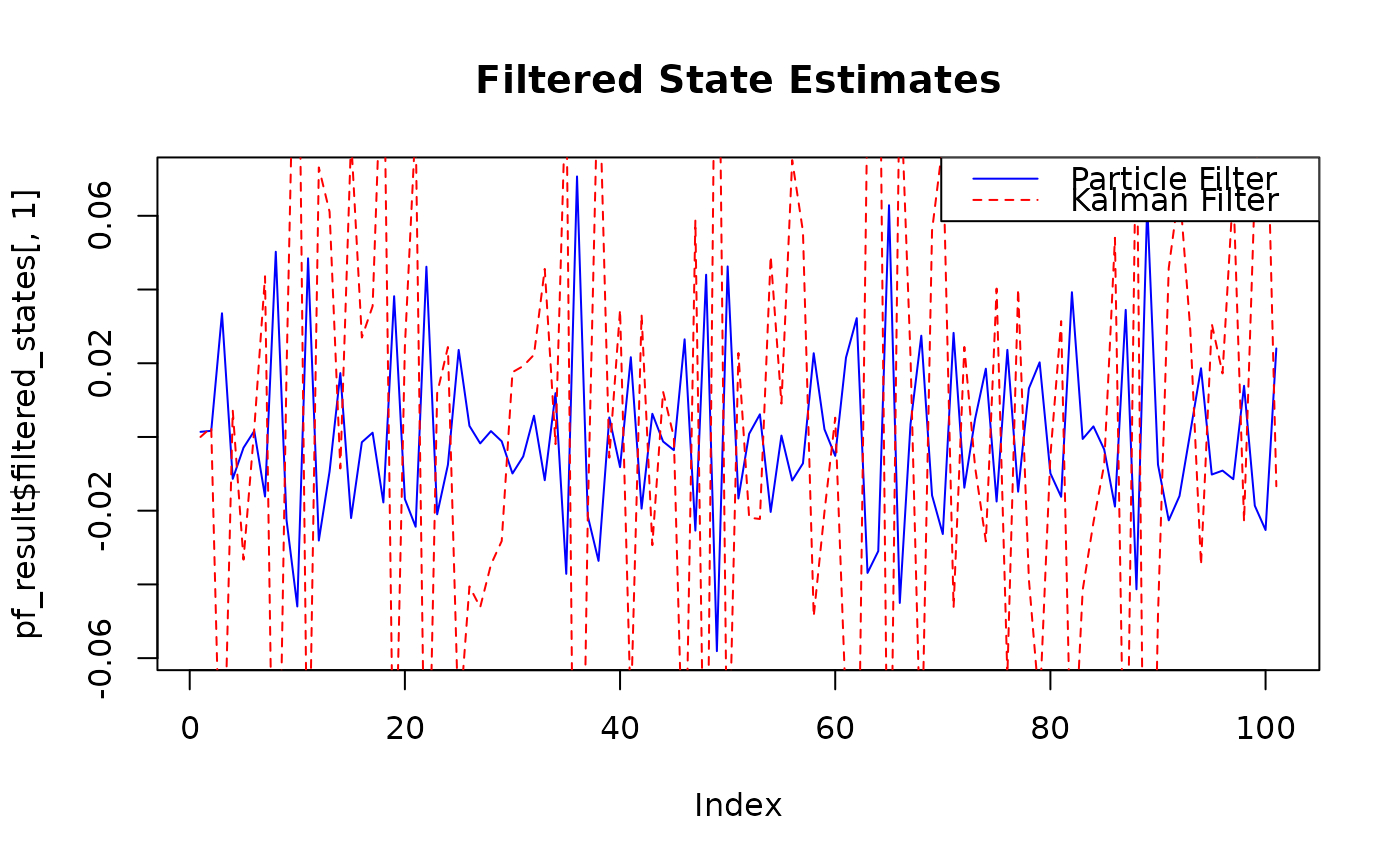
# Plot filtered states comparison
plot(pf_result$filtered_states[,1], type = "l", col = "blue",
     main = "Filtered State Estimates")
lines(kf_result$a[,1], col = "red", lty = 2)
legend("topright", legend = c("Particle Filter", "Kalman Filter"),
       col = c("blue", "red"), lty = 1:2)